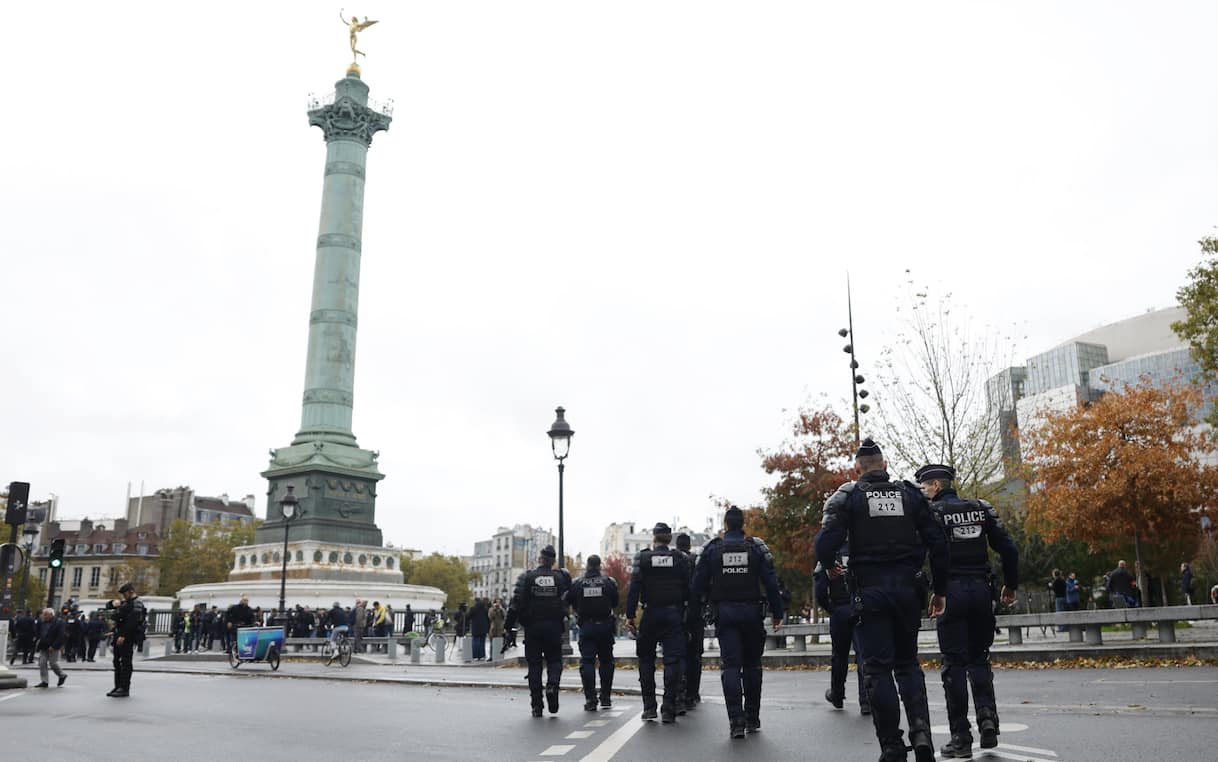
France held a nationwide day of industrial action on Thursday, with unions organising roughly 260 demonstrations in cities across the country, according to Sky TG24. Salaried employees and public-sector staff took to the streets over pay, and students and pensioners were also urged to take part. The main procession was in Paris, where tensions flared.
Sophie Binet, general secretary of the Confédération générale du travail (CGT), said the union had counted more than 250,000 demonstrators across 73 cities. Speaking to reporters before the Paris march set off, she said the only thing that would end the movement was a response to its demands. She also warned the government that the longer it waited, the higher the cost would be.
The Interior Ministry's office gave a different tally, according to Sky TG24: 270,000 people in 180 processions by 1pm, excluding the capital. Authorities had labelled the day a "black Thursday" and deployed 70,000 police officers and gendarmes to keep order.
Why it matters
The dispute is primarily about wages, but its reach extended well beyond the workplace. Schools, universities, trains, metros and major tourist sites were all affected, and the day produced outbreaks of vandalism that drew condemnation from ministers. The gap between union and government crowd figures is a familiar feature of French protest days, but it also signals that both sides are still positioning themselves rather than negotiating.
Binet told the press that the march route through central Paris was not exactly the one the union had wanted, though it did pass through the city centre. Sky TG24 reported that security was a concern both in the capital and in other major French cities.
Schools targeted and a stabbing outside Paris
Several lycées were set on fire during the day. One was the Françoise high school in Tournefeuille, near Toulouse. According to the account reported by Sky TG24, intruders got inside the building and fired fireworks from mortar tubes, setting part of the premises alight despite firefighters arriving quickly. Computers were also destroyed.
Kamel Chibli, vice-president of the regional council, called the acts unacceptable and urged everyone to condemn them firmly, asking for exceptional measures and penalties matching the seriousness of what happened.
Education Minister Édouard Geffray described the arson near Toulouse as scandalous criminal behaviour that put pupils and staff at risk. He expressed support for the headteacher, staff, students and their families, thanked firefighters and police for limiting the damage, and said no cause could excuse or shield criminals. Those responsible would answer before the courts, he said.
A fire was also started at a school in Rennes. Firecrackers were thrown at officers in Paris's 14th arrondissement, in Savigny-le-Temple in Seine-et-Marne, and near the Brossolette high school in Villeurbanne, according to Sky TG24.
In La Courneuve, in the Seine-Saint-Denis department north of Paris, an 18-year-old stabbed a peer who was setting bins on fire outside the Denis Papin high school, Bfm TV reported, as cited by Sky TG24. The victim was wounded in the chest but not seriously, and the circumstances and motive were still being established. The assailant reportedly tried to go after other students before police stopped him.
In Lille, burning rubbish bins near a gas pipe in front of the César Baggio high school caused a significant gas leak, the prefecture for the Hauts-de-France region and the Nord department said. Nearby buildings were evacuated and a safety perimeter set up.
Several hundred people formed a black bloc in Lyon and were kept under surveillance by police, Sky TG24 reported. Early incidents were also reported in Nantes as a march dispersed.
How many schools were affected
The government said about 2.2% of French high schools — 81 out of 3,700 — were blocked by students. The Union syndicale des lycées put the figure at 1,000 schools "not at work", a count that combines student blockades with closures for administrative reasons.
The Education Ministry said almost 16% of teachers were on strike and about 33% of higher-education institutions, 60 out of 184, were affected by disruption.
Transport, museums and the Eiffel Tower
Travel was disrupted from the morning, starting with trains and metro services, according to Sky TG24. The Eiffel Tower was closed to visitors because of the national strike called by the unions, its operating company announced on its website. Some rooms of the Louvre were also shut for the day.
Unions had called on both public- and private-sector workers to walk out over pay. Sky TG24 reported that young people and pensioners were invited to join the action alongside employees.
The day's events put the government under pressure on two fronts at once: the wage demands at the centre of the strike, and the disorder in and around schools, which ministers were quick to frame as criminal rather than political.
What to watch next is whether the government offers anything on pay that the CGT and its partners consider a sufficient response, and whether the school unrest continues into the coming days. Binet's warning that delay raises the price suggests the unions intend to keep the pressure on until they get an answer.